As part of our content series exploring children and young people engagement strategies and what we’ve learned from co-creating behaviour change campaigns with children and young people, we’re thrilled to share our latest article – Our Story in Practice.
In the first part of the series, we highlighted the importance of listening when collaborating with children and young people to create meaningful, lasting change that truly resonates. Challenging assumptions and centring their perspectives, thereby making a genuine difference. Building on our listening journey through this story in practice, we wanted to take the opportunity to show how our commitment to listening to young voices is embedded in the way we work.
Here, we share a selection of projects delivered with some of our clients, where we have used children and young people engagement strategies. Through innovative and creative approaches, we have created space to truly listen to their experiences and enable them to shape the interventions designed for them, with them.
Across these three projects, we demonstrate that meaningful listening especially happens when we meet young people where they are in spaces where they feel safe to share openly, honestly, and authentically. This may be online through digital platforms, at a Scouts group on a Thursday evening, or at school with trusted staff members.
Of course, finding the ideal setting for open and fruitful discussion is often shaped by practicality rather than choice. Safeguarding is always our highest priority, which means collaboration must take place in environments that are safe and appropriate.
These projects highlight the many ways honest listening and genuine collaboration can take shape across different contexts as well as purposeful listening and making real change that resonates with children and young people.
Case Study: “Keep Your Cool, Ditch the Vape’
Commissioned by: Tameside Metropolitan Borough Council to help children and young people at a critical age when beliefs and behaviours are embedding and habits are forming, to choose vape-free lives.
Setting: School classrooms
Approach: Co-creation workshops
Our Challenge
For this project, we wanted to gain insight into motivations for vaping in children and young people at a formative age – when beliefs and behaviours are embedded, and habits are forming. However, vaping is often treated by schools with a hardline disciplinary approach. This makes students hesitant to speak honestly for fear of consequences. Our goal was to break through this barrier and create an environment in which young people would openly share their thoughts and experiences on this topic. This would enable us to develop a campaign with a distinct youth voice. The campaign would reflect their lived experiences without being confused with adult-centric NHS smoking cessation messaging.
Our Method
Creative listening helped us bypass the formal, authoritative feel of the school environment through the use of interactive co-creation workshops. Instead of direct questioning, we used visual cut-out boards and messaging sets to spark peer-to-peer debate. This enabled us to
- Build trust by creating a space where young people could share without fear of judgment.
- Test resonance by presenting two distinct creative and linguistic routes separately, ensuring feedback was based on substance rather than just design.
- Identify drivers by uncovering the real social pressures and misconceptions driving youth vaping habits.
Our Impact
By using creativity as a tool for this children and young people engagement strategy, young people’s voices became the foundation of the campaign. This enabled us to collaboratively shape an intervention that spoke directly to the audience it was designed to reach, addressing this prevalent health challenge while remaining clearly distinct from NHS efforts targeting adults.

Case Study: “Children and young people’s engagement: Extreme breeding of pets”
Commissioned by: RSPCA
Setting: Extra-curricular activities – Scouts
Approach: Interactive group activities
Our Challenge
Another example of our commitment in action is our project with the RSPCA, which aimed to understand young people’s perceptions of extreme breeding. To reach a diverse group of 12–18 year olds, we moved beyond traditional research settings and worked through trusted community gatekeepers.
One of the most effective environments was local Scouts groups. By joining participants during their regular Thursday evening sessions, we were able to:
- Foster comfort and trust by facilitating discussions in a safe and engaging way with trusted individuals, such as youth leaders. Working with people they feel comfortable with helped the young people feel confident in sharing their genuine views.
- Encourage open and honest engagement. The familiar and relaxed community setting enabled more natural and productive conversations than a formal classroom environment.
- Facilitate interactive learning. Moving away from rigid surveys and structured focus groups and instead using innovative activities to spark discussion and authentic reactions.
Our Method
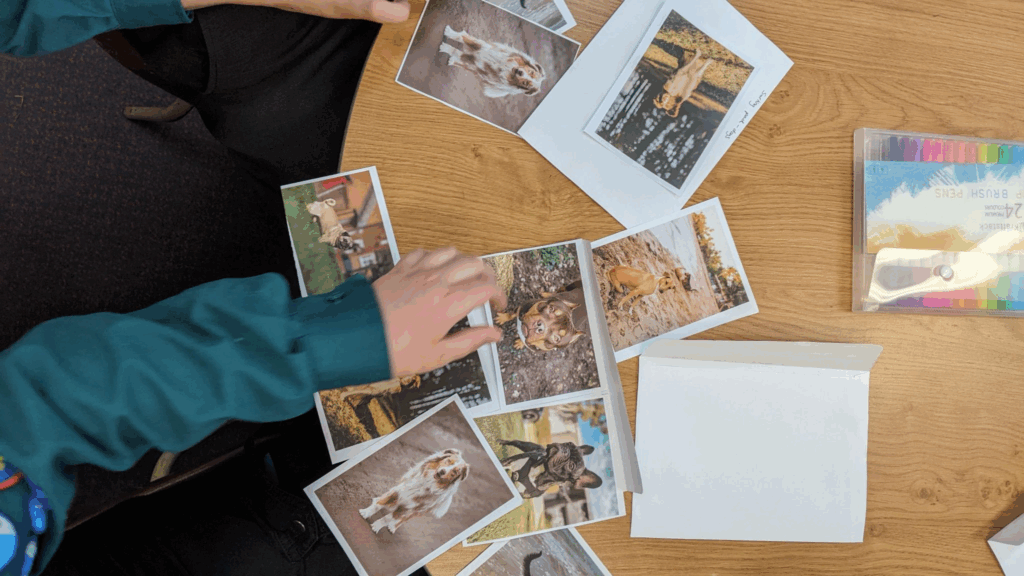
One example of how we gathered deeper insight during fieldwork was through a photo-sorting activity. Scouts were asked to organise images of pets from “most cute” to “least cute”, and then from “most healthy” to “least healthy.”
This exercise quickly revealed how young people perceived extreme breeding, uncovering their moral reasoning, emotional responses, and underlying beliefs. It also highlighted opportunities to use empathy-led messaging to address the issue more effectively.
Our Impact
This project demonstrated that when we meet young people in environments where they feel comfortable, can have fun, and are offered meaningful ways to engage, we gain not just data, but richer, more authentic insights. We also develop informed and motivated contributors whose perspectives help shape impactful strategies for behaviour change.
Case Study: Screen Off, Life On!
Commissioned by: JU:MP (Join Us: Move. Play.) Local Delivery Pilot (LDP)
Approach: Digital Co-creation
Our Challenge
Many children and young people increasingly find themselves trapped in a cycle of passive scrolling. Our research found that 84% of Bradford parents wanted their children to spend more time playing outdoors rather than on screens. The challenge was to motivate 9 – 14-year-olds and their families to swap some screen time for active, off-screen play. This also needed to be in a way that felt like a positive choice rather than a restrictive rule.
Our Method
We recognise that young people increasingly inhabit online spaces, making these environments crucial for the children and young people engagement strategy and capturing authentic youth voices. To develop a campaign that encourages them to spend more time outdoors, we explored how to leverage their digital presence as a tool for real-world engagement. As always, rather than relying on assumptions, we tested our concepts directly with the young audience.
Working with the Youth Design Group became the foundation for shaping our delivery approach. Through this process, we explored which digital spaces and types of content would most effectively motivate young people to get outside. The participants helped identify which formats and messaging would resonate online and inspire real-world activity.
Our findings included:
- YouTube Shorts is the preferred platform for shooting, sharing, and watching short videos that encourage movement.
- TikTok is a popular space for inspiration through short, snappy, and relatable content.
Our Impact
The Screen Off, Life On! approach demonstrated that small, positive shifts in behaviour can lead to meaningful change. Children and young people in the JU:MP area were more active overall, achieving higher levels of daily moderate-to-vigorous physical activity compared to those outside the programme. This increase was particularly noticeable during weekdays, suggesting that the campaign successfully influenced everyday routines.
Encouragingly, the programme had an even greater impact among children from ethnic minority backgrounds, contributing to a reduction in physical activity inequalities. By meeting young people where they are both digitally and culturally, the campaign created more inclusive opportunities for active play. When engaging with young people digital spaces can serve as a springboard to successfully inspire them to make healthier choices.
Find out more
You can find out more and read part 1 of this content series here</a>, or get in touch if you’d like to explore how Magpie could support your organisation to help improve the lives of children and young people across the country.
Get in touch