
The most impactful audience segmentation doesn’t just tell you who your audiences are. It tells you why they might act, what might stop them and what they need to hear next.
What is audience segmentation?
For charities and purpose-driven organisations, understanding your audience is rarely as simple as knowing their age or demographics. People can have very different levels of confidence, knowledge and readiness to act, even when they appear to belong to the same audience group.
So how can charities and purpose-driven organisations create communications that engage diverse audiences who are different points in their engagement journey? The answer could lie in looking beyond who people are and understanding why they behave the way they do. A behavioural approach can reduce running costs, navigate complex challenges and promote positive social change.
Why demographic segmentation isn’t always enough
As part of our industry outreach, we spoke to Lee Read, Prevention and Education Project Lead at the RSPCA, about how people’s learning and engagement rarely follow the expectations we might have based on age alone:
We have a rough ‘expectation’ for what different age groups should learn, but reality rarely follows that structure. There are some incredible young people learning beyond their years. We also have adults who are just being introduced to making a better world for animals.
Lee Read, RSPCA Prevention and Education Project Lead
This is where a behavioural approach to audience segmentation can make a difference. Whether you’re looking to educate the public, engage your community or recruit volunteers, understanding people’s motivations, barriers and readiness to act can help you create content that meets them where they are.
In this article, we’ll explore how charities and purpose-driven organisations can use behavioural insight to segment their audiences and design communications that inspire more people to take action.
How behavioural insight can reveal what motivates your audience
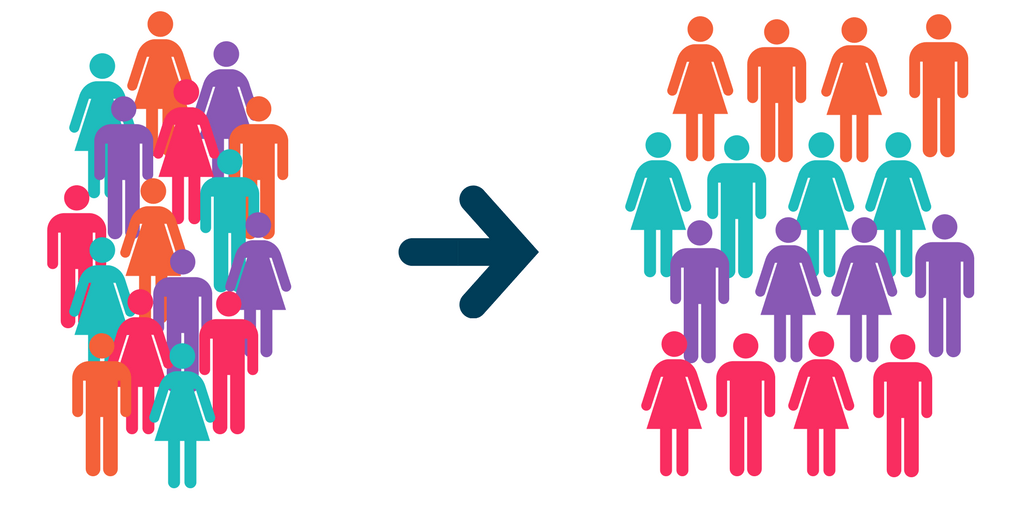
Grouping audiences by demographic buckets like ‘families’, ‘youth’, or ‘adults’ can sometimes limit the reach and impact of content. We might assume that people of the same age share the same motivations, but this is rarely the case. Instead, we can look towards ‘psychographic’ segmentation, which groups people by how they think, feel, and believe in relation to your cause.
Example: Using behavioural segmentation to understand recycling
To understand what this means in practice, consider a project Magpie delivered on recycling behaviours in Merseyside. We found that the reasons people do not recycle are rarely tied to their age or postcode. Instead, they are rooted in deeper psychological barriers. This led to profiles like the ‘Inconsistent Recycler’ who just lacks time or consistent motivation, the ‘Complacent Recycler’ who believes they already do enough, and the ‘Confused Recycler’ who lacks knowledge.
Example: Using audience insight to encourage fostering
We can take this a step further to see how psychographic segmentation directly guides a targeted strategy. For the Foster for Greater Manchester programme, we mapped potential foster parents not by their demographics, but by their psychological readiness. We broke down our warmest audience into psychographic profiles, ranging from ‘The Timing-Dependent Planners’ to ‘The Financially Cautious’ and ‘The Socially Driven Caregiver’.
By mapping these psychological commonalities, we were able to build a highly tailored communication funnel. For audiences at the top of the funnel, we prioritised broad awareness and education. In the middle, we focused on fostering community connections. At the bottom, for groups like ‘The Open but Hesitant’, we designed content focused on confidence-building and real-world exposure to encourage that final step. This approach allows us to meet people exactly where they are on their journey before asking them to change their behaviour.
How to keep things accessible without talking down to people
Once we understand our audience’s mindsets, we face the next challenge of designing content that speaks to them appropriately. How do we keep introductory content accessible for new supporters without making adults feel like they are being spoken to like children?
The solution involves separating how easy something is to understand from how difficult it is to actually do. In simple terms, this means keeping your language warm, simple, and easy to read for everyone, while separately adjusting the physical effort, time, or skill required to complete the volunteering action.
When we untangle these two concepts, we avoid a common digital pitfall. To help audiences find the right starting point, organisations sometimes label basic educational tasks with age categories. RSPCA’s Lee Read recently told us that filtering content by age can feel like the most natural approach when designing activities, but activities inevitably cross into different age groups when mapping animal welfare literacy. For example, a 3-5 year old might ‘help out’ by feeding pets, but checking whether pets have been fed requires practicing responsibility, a skill more commonly expected from a 7-11 year old. Fundamentally, both activities are an entry-level learning experience, and it should be up to the learner or educator to determine how that unfolds, rather than restricting it with an age-based label.
Age-based labels such as “For ages 3+” can unintentionally make older beginners feel that an activity is not meant for them. This can create embarrassment or concern about being judged, putting people off content that would otherwise be a useful starting point. Instead of focusing on the engaging activity at hand, volunteers end up wasting unnecessary mental energy wondering if the materials were truly meant for them in the first place.
How to create content for audiences at different stages
To resolve this friction, we can build a ‘learning ladder’. This means replacing age-based labels with a skill-based journey, using terms like Beginner, Intermediate, Experienced, and Master.
As RSPCA’s Lee Read reflected, applying this progression approach “sets the expectations for each activity in a better light”. Some activities sound incredibly simple on paper, such as making a safe space for pets. However, in reality, this is quite a technical ask when considering whether the animal actually feels safe, for instance, evaluating if they can hear strange sounds or feel vibrations. By framing this as a progression of skills rather than an age-bracketed task, we honour the complexity of the action.
A ‘Beginner’ tier invites young people to start engaging while acting as a dignified, non-stigmatising entry point for older adults without worrying about being judged for engaging in content for younger people. Creating a ‘learning ladder’ gamifies the supporter experience in a healthy, informational way.
Self-Determination Theory
According to Self-Determination Theory (Ryan & Deci, 2000), this skill-based progression systematically satisfies three foundational human needs:
- Competence: Progression tiers help users see their own growing skills and capability, rather than making them feel they are completing tasks meant for children.
- Autonomy: Users stay in control of their own journey, choosing their starting point based on their actual skills rather than their age.
- Relatedness: It helps volunteers feel like active members of a shared community, uniting people through a collective goal rather than dividing them by generation.
By building this learning ladder, we allow disengaged audiences to start small, build self-efficacy, and experience positive emotions. In essence, this ladder serves as a tool for gamifying engagement. However, we must be incredibly mindful of how we design the rewards for people. We do not want to crowd out their intrinsic motivation by making an extrinsic reward more appealing than the cause itself. We want the positive emotions experienced after progressing to the next level, and the opportunity to signal their identity within the community of supporters, to be enough to reinforce their motivation to engage. This ensures they stay connected to the heart of the charity, rather than switching to thinking that progression will bring them some tangible extrinsic reward.
How audience segments can shape communications
Once we understand the different mindsets within an audience, we can use those insights to shape the digital experience. This does not necessarily mean creating a narrowly targeted advertising audience for every segment. People’s motivations and barriers rarely correspond neatly with the targeting options available on digital platforms.
Instead, segmentation helps us decide what to say and how to say it. We can develop different combinations of messaging, imagery, formats and calls to action, each designed around a particular motivation or barrier. Relevant audience signals – such as location, interests, previous engagement or first-party data – can help guide delivery, while still giving platform algorithms enough flexibility to find the people most likely to respond.
For example, a potential foster carer who is worried about the financial implications might need clear information about allowances and practical support. Someone who feels emotionally ready but lacks confidence might respond better to an honest story from an existing foster carer and an invitation to attend an informal information session. We can then test which messages, creative styles and next steps encourage meaningful action. This gives organisations useful evidence about what their audiences need, helping them improve everything from advertising and social content to emails, webpages and supporter journeys.
A smarter approach to audience segmentation
Ultimately, combining psychographic segmentation with competency-based design allows charities to create a single, cohesive content hierarchy. Your language remains universally accessible, but the complexity of the action scales with the user. The result is a welcoming environment that avoids alienating beginners, keeps your experienced advocates inspired, and makes your resource allocation much more efficient.
Turn audience insight into action
At Magpie, we combine behavioural science, audience insight and creative communications to help charities understand what motivates people, what gets in the way and what can inspire action.
Whether you’re trying to engage new audiences, change behaviour or build deeper connections with existing supporters, we’d love to explore what could work for your organisation.
Talk to us about your audience challenge