Back when I was studying for my degree in English Literature and American Studies at the University of Manchester (UoM), I met someone who inspired me so much that I still think back on our conversations some 15 years later.
At the time, Dr Monica Pearl was teaching literature, film and queer studies at UoM, and as a fresh-faced undergraduate student, I was drawn to her ‘like a moth to a flame’ (Janet Jackson reference very purposeful). Over many lectures and seminars, I learned about Dr Pearl’s role in ACT UP New York (an international grassroots political group working to improve the lives of people with AIDS through direct action, medical research, advocacy, and legislative change). Dr Pearl was also instrumental in supporting one of the first needle exchange programmes in New York (you can find out more in the ACT UP Oral History project here).
I was so inspired by this human, I chose to focus my dissertation on the representation of HIV and AIDS in UK and US media. Much of the research I explored – the lived experience oral histories, testimonials and the memoirs – has fundamentally shaped how I see the world around me. I’ve seen how deeply stigma can root itself in public perception, and I recognise how insurmountable the barriers can feel for people trying to access the care and support they need.
This is a major reason I was so enthusiastic about applying Magpie’s expertise to this topic. The opportunity arose to support Terrence Higgins Trust in developing a pilot campaign to help people living with HIV who have disengaged from care to reconnect with support services.
As of December 2023, 4,960 adults with HIV in England had not been seen in care for at least 15 months. However, when the scope is widened to include those not seen since 2017, the number rises significantly to 12,065 – about 10% of all people living with HIV in England.*
This presents a real challenge for people living with HIV, the NHS and for charitable organisations providing support in this space. Without HIV treatment, there is a risk of onward HIV transmission and a weakening of the immune system that can lead to serious illnesses.
People living with HIV may disengage from care for many reasons, and many of these reasons aren’t exclusive to HIV care. Mental health challenges, substance abuse, poor healthcare experiences, migrant status, unstable housing situations and caring responsibilities are just some of the factors involved. In some cases, it can be a blend of different reasons but fundamentally underpinned by a fear of the stigma associated with sharing your HIV status.
For decades now, Terrence Higgins Trust has been at the forefront of the movement to support folks living with HIV, striving for a future with no new HIV cases, where people living with HIV get the support they need, and ending stigma and discrimination. Their mission:
- End new cases of HIV in the UK by 2030
- Supporting people with HIV to live well
- Eradicate HIV-related stigma.
The goal was to design and deliver the HIV Reconnect Campaign, a targeted initiative to re-engage the estimated 5,000–12,000 people living with HIV in the UK who have fallen out of care. Terrence Higgins Trust purposefully decided to pilot this campaign in London and Glasgow: London, as the region with the highest percentage of people who have disengaged from care, and Glasgow, to provide further geographical insight. The objectives were:
1. Reach and reconnect people not retained in HIV care.
The primary objective was to reach and reconnect individuals who have fallen out of HIV care. This involved implementing targeted strategies to identify and engage those not retained in care, encouraging them to resume regular consultations.
2. Encourage calls to THT Direct helpline.
Encourage individuals not attending their HIV clinic appointments to call the THT Direct helpline for personalised support in locating an HIV clinic and making an appointment. THT Direct serves as a crucial resource for re-establishing a connection to care, as well as signposting to peer support services.
3. Raise awareness across the health system.
Disseminate information and awareness regarding the importance of returning to HIV care throughout the health system, including GP practices and hospitals.
At Magpie, we’re experts in understanding how to engage people with care services and how to navigate health systems. We knew we needed to deliver a compassionate, co-created campaign toolkit underpinned by behavioural theory to re-engage people with the care they deserve. Additionally, having the opportunity to work closely with Terrence Higgins Trust, the leading national HIV charity, meant we could combine our efforts, learn from each others’ expertise and enhance our collective impact.
Initially, our Behavioural Insights team undertook a national and global academic review to help us better understand the behavioural domains of disengagement – essentially, why people make decisions to not attend clinic appointments.

Our approach linked motivations and belief systems to a multi-level re-engagement strategy, guided by existing literature, case studies, people with lived experience and evidence-based messaging designed to reach underserved communities. Crucially, the creative strategy needed to be grounded in behavioural science to ensure that every message resonates with the lived experiences and belief systems of people living with HIV who may have disengaged from care. Our goal was to create a social norm around HIV care, rather than focusing on the number of people living with HIV not in care.
By considering key behavioural domains, such as emotional drivers, perceived barriers, and social support we are able to design communications that reduce anxiety, challenge fears of judgement, and highlight the supportive networks available.
The team at Terrence Higgins Trust gathered insights from people living with HIV who had previously experienced disengaging from their HIV clinic through one-to-one interviews. Using these insights, we were able to develop different messaging and designs, which we further tested with the campaign’s intended audience.
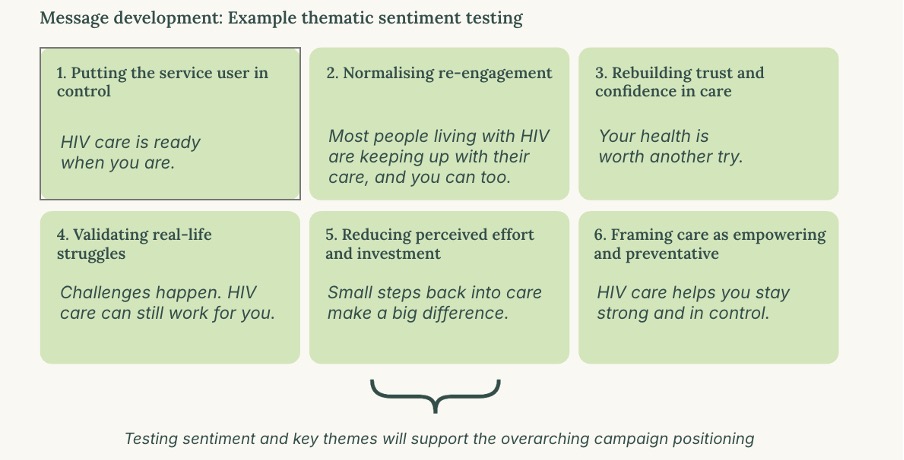
After audience testing in collaboration with Terrence Higgins Trust, the campaign’s primary strategy drew from the following:
Rebuilding trust and confidence: Shifting the sentiment ‘Your health is worth another try’ to ‘It’s worth another try’, a broader statement allowing for more motivations to be built into secondary messaging.
Normalising reengagement: Through social modelling, delivering the reasons a number of different people re-entered care to create a sense of ‘possibility’.
We were then able to create ‘reasons why’ people re-engaged with care; building in messaging to include ‘the validation of real-life struggle’, ‘reducing the perceived effort and investment’ and ensuring we are ‘putting the service user in control’.
What followed was a process of distilling insights gleaned from lived experience and channelling them into creative assets; film, imagery and messaging that emphasise openness, reassurance, and encouragement.
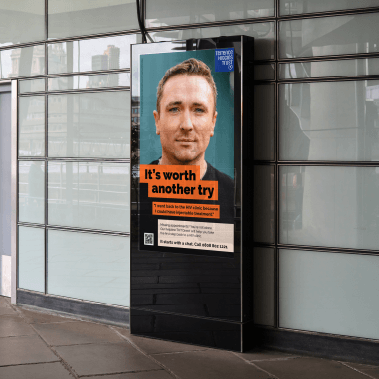
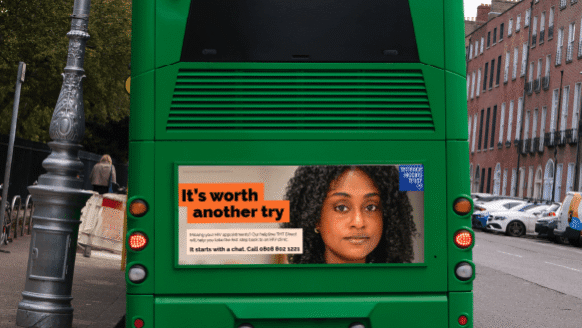
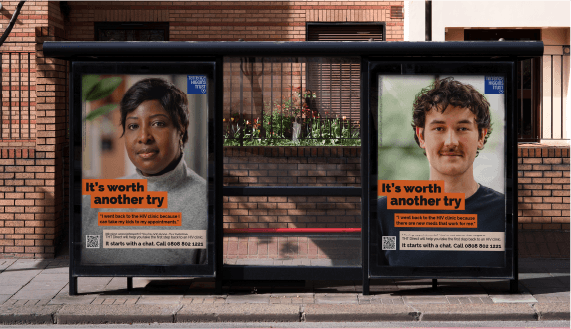
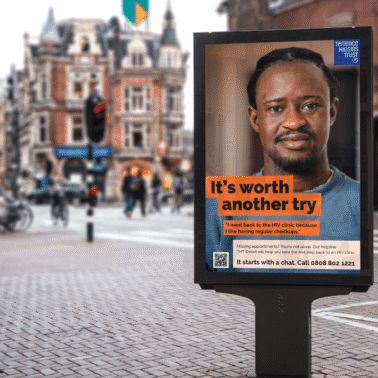
Currently, the ‘It’s worth another try’ campaign is live with Out of Home adverts in London and Glasgow, and it is also being promoted on key digital platforms (Instagram, Spotify, dating apps, etc). The Magpie team was so proud to partner with Terrence Higgins Trust and support their mission to re-engage people living with HIV who have disengaged from care. Working with clients who share our values and vision is part of the reason we continue to do what we do.
I’m lucky I had the likes of Dr Pearl to teach me about the history of HIV care and the value of human (re)connection. For me personally, this collaboration with Terrence Higgins Trust reminds me how glad I am to be part of a team addressing real health inequalities in communities and tackling society’s big challenges.
If you are able, I urge you to get involved and show your support for ‘It’s worth another try’.
How can you support this campaign?
- Access the Trello board to download and share social media assets (use #AnotherTry and tag Terrence Higgins Trust)
- Display digital posters in your services (available on Trello)
- Direct people to the campaign webpage or THT Direct
- Encourage services and organisations to get involved.