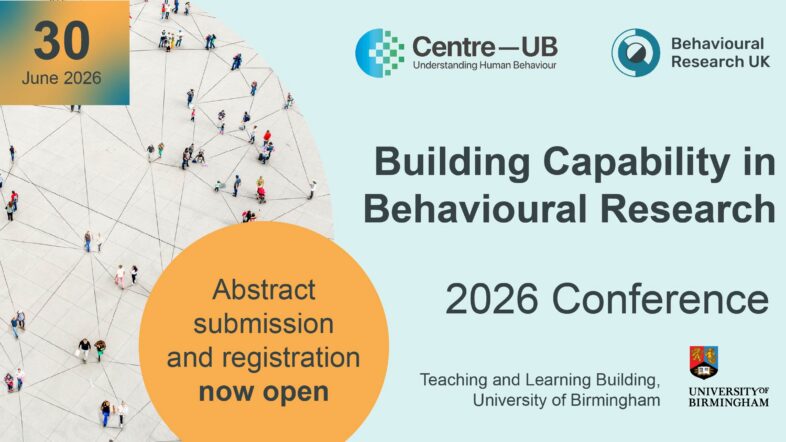
The much-anticipated Behavioural Research UK (BR-UK) Conference 2026 took place in Birmingham on 30 June, bringing together academics, industry professionals, and change-makers focused on one central mission: building capability in behavioural research.
It was a phenomenal day of learning, absorbing disruptive ideas, and networking with some of the most passionate minds in our field. Here are the key moments that stood out from the conference.
1. The Power of “Boosting”: Investing in Human Competence
The Behavioural Research UK Conference 2026 opened with a captivating keynote by Professor Ralph Hertwig on ‘Boosting’ and its applicability in public policy, chaired by the renowned Professor Susan Michie (BR-UK Co-Director).
In particular, Professor Hertwig pointed out that the pathway of ‘learning’ does not appear even once in the index of Nudges. Importantly, his talk made a powerful case for shifting our focus toward investing in people’s competence rather than just altering their environments.
To illustrate this, he mapped out four fascinating paradigms of human decision-making:
- The Intuitive Statistician: Where our understanding of choice is shaped by experimental methods and accumulated experience over time.
- The Smart Heuristic: Where rationality is derived from specific features within our social and physical environments.
- Naturalistic Decision-Making: Which relies on intuition and naturally evolved cognitive capabilities.
- Bayesian Models of Cognition: Where we attribute likelihood to choices based on probabilistic factors.
Ultimately, the takeaway was that no matter which paradigm you align with, sustainable behaviour change cannot exclude learning. Human capability shouldn’t be underestimated. Equally importantly, the philosophy of “boosting”, places radical trust in building and strengthening competencies so citizens can autonomously enable positive behaviours. For example, we saw brilliant real-world examples of this in action:
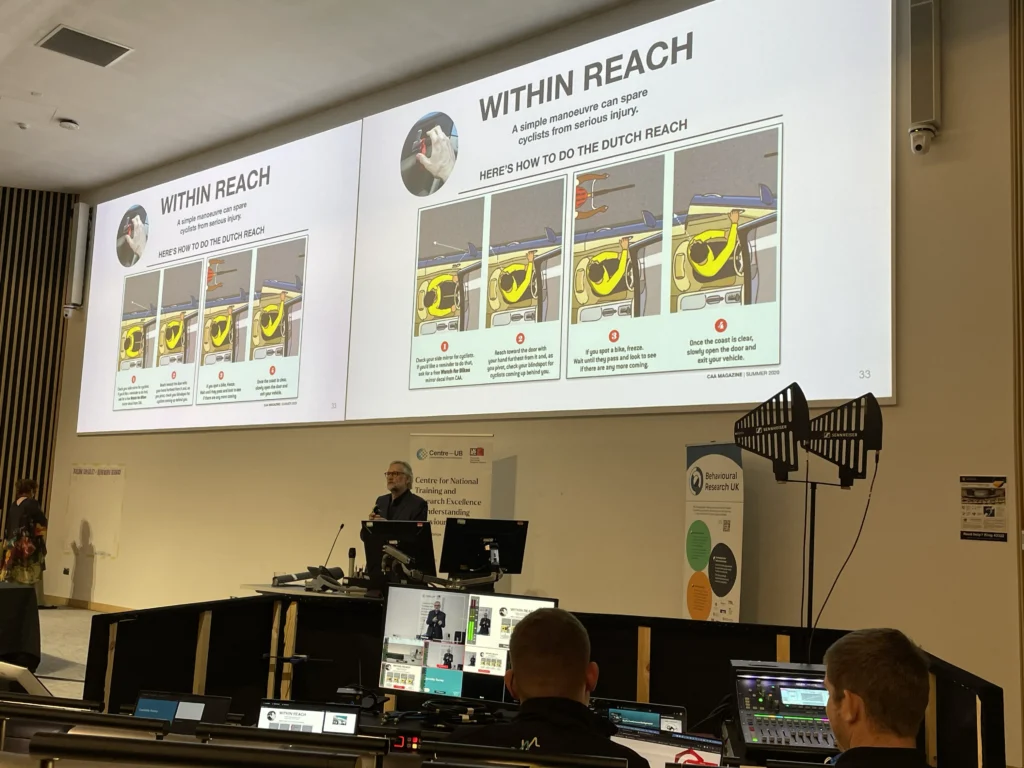
- The ‘Dutch Reach’ maneuver: Teaching drivers a specific way to open car doors to protect cyclists.
- The Bedtime Math website: Improving math competency among young people through daily engagement.
- The One Sec App: Reducing social media screen time by intentionally introducing friction to engage the user’s reflective brain.
2. Magpie on the Ground at the Behavioural Research UK Conference 2026
Following the keynote, the oral and poster presentations were masterfully segmented across four critical themes: Decisions, Data & Policy, AI & Digital, Health & Wellbeing, and Environment & Sustainability.
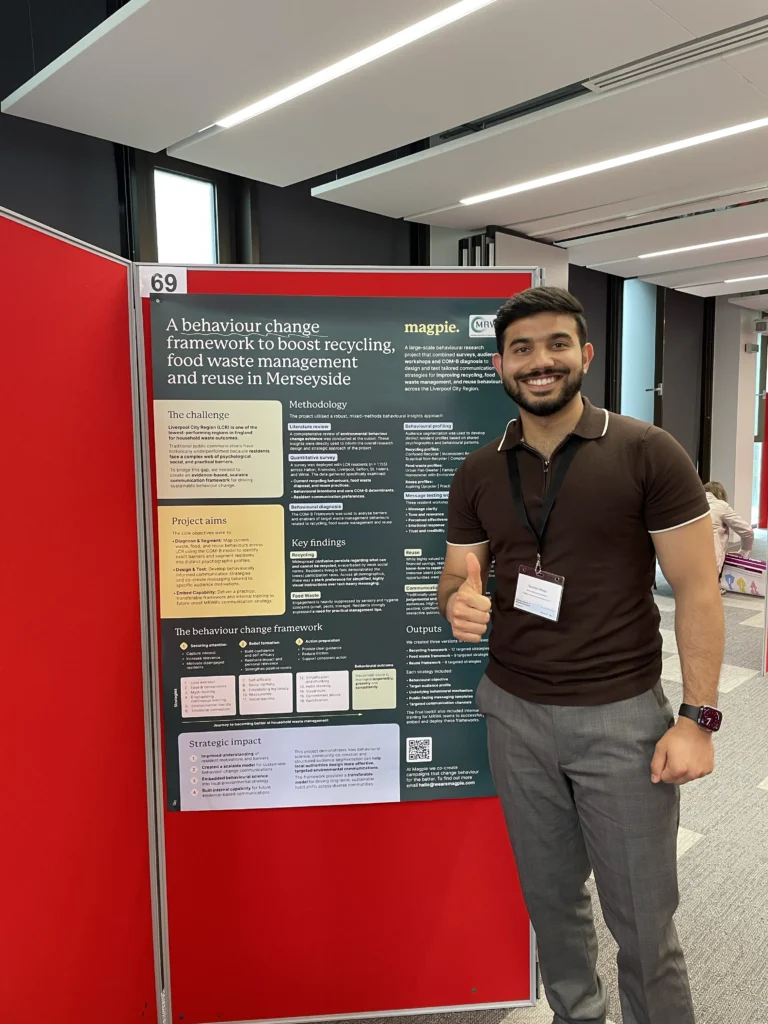
Meanwhile, the Magpie Behavioural Insights Team was out in full force, presenting posters on two of our incredibly impactful behaviour change projects. Aligning well with the keynote theme, both of our projects focused on the philosophy of boosting:
- Increasing cancer screening uptake in Bradford’s diverse communities (Health & Wellbeing category)
- A behaviour change framework to boost recycling, food waste management and reuse in Merseyside (Environment & Sustainability category)
As a result, both posters sparked fantastic discussions and immense interest from delegates. Furthermore, we are absolutely thrilled to share that our Merseyside waste management project won first prize in the Environment & Sustainability category at the Behavioural Research UK Conference 2026! It’s an incredible testament to the team’s hard work and our commitment to high-impact, evidence-based intervention design.
3. The Ultimate Debate: Who Owns Trust: Public or Experts?
Another highlight of the Behavioural Research UK Conference was was a live debate: “Who owns trust? Is trust in behavioural policy better supported by ‘experts’ or ‘deep public engagement’?”, chaired by Professor Jet Veldhuijzen van Zanten (University of Birmingham).
The arguments on both sides were compelling:
The case for Deep Public Engagement: Dr. Marco Bardus and Professor Oliver Escobar argued passionately that public engagement is vital for democratic legitimacy. They warned that top-down decision-making creates siloed disciplinary boundaries. This ultimately restricts real-world impact.
The case for Experts: Dr. Richard Amlôt (UK Health Security Agency) and Dr. Rachel Singleton (Ulster University Business School) pushed a strong counter-stance. They argued that experts are a necessary precursor to engagement; they design the fundamental aspects of policy and ensure robust methods are embedded consistently. Moreover, they create the frameworks that allow diverse public voices to be safely and reliably represented.
The twist in the climax: A live poll was taken before and after the debate. Initially, an overwhelming majority voted in favour of public engagement. However, the “expert” team delivered such a bulletproof closing argument that they completely swung public opinion. They won the debate by shifting the room’s votes. It was a thrilling, brilliant exercise in perspective-taking.
4. Bipartisan Climate Messages & The Future of Behavioural Research
The afternoon featured several other standout sessions that gave us plenty of food for thought:
- The Next Gen of Research: Professor Paul Taylor (Lancaster University & Advisor to Science and Technology in Policing) explored successful examples of research translating into tangible policy impact. He mapped out vital lessons for the next generation of behavioural researchers. It is important to demonstrate ‘quick wins’ to get buy-in for one’s approach. Once trust is earned, then one can scale impact through powerful behavioural research.
- The Power of Scientific Consensus: Nick Pidgeon (Cardiff University) presented a massive US mega-study that tested 10 different framings of climate-related messages across a massive sample size. The clear winner? Framing that implied clear scientific consensus. Crucially, this framing positively impacted pro-environmental beliefs and intentions without varying between Republicans and Democrats. This result is a massive win for depolarising critical science communication.
Looking Ahead
Leaving the Behavioural Research UK Conference, the overarching feeling is one of immense optimism. Whether we are boosting public competence, navigating the boundaries of expertise and public trust, or finding common ground on climate action, the future of behavioural research is bright, collaborative, and deeply human.
We’re incredibly proud of the Magpie team’s win, and we’re more ready than ever to apply these fresh insights to our upcoming projects. If you’re curious to explore how these behavioural concepts can empower your community, or if you have a specific behavioural challenge you’d love to solve together, get in touch with the Magpie team today to schedule a chat.
Get in touch
Contact the team to find out more or book in a time to discuss further.
Contact us